By Mr. GeckoBiHu
(scroll down below for more information about this article and the author)
In 2018, a genius game developer named “yeo” living in Moscow broke into the gaming sphere with his 8-bit retro style beat'em up RPG The friends of Ringo Ishikawa. About a rebellious Japanese high school student Ringo and his friends’ last autumn as high school students, it’s like the Kunio-kun series are modernized, but in a reverse gesture, by introducing concepts of “passing time” and the “elimination of objectives”, brings an unresolvable sadness of being into this old genre. Most of the time in this game, except for some key plot points, we are not forced to complete any objectives. The game won’t even teach you how to play it. You can go to class, have small talk with your mate on the school roof, pick some other school students with different color uniforms to fight randomly on the streets, go to the gym to train yourself, or miss everything mentioned above entirely and just wander around the streets. You can smoke a cigarette on a park bench in the middle of the night, or you can eat nothing but will never “starve to death”; You can just sit on your bed “playing video games”, or just do absolutely nothing, and time just passes through your eyes. In most sectors of the game, the progression system is “objective-free”, time itself becomes the progression. So you can also go to the bookstore, buy a book and “read” it, for example, “FD’ Brother”– a naughty reference of Fyodor Dostoevsky's The Brothers Karamazov– but you won’t actually “read it”. You just press a button, and see Ringo’s gesture of holding the book and the numbers indicating pages running. And when the number reaches the end, see Ringo’s one line remark on it. The “time” you “press the button” is the “time” you “read”, although we don’t actually “read” anything. So even we are still left with various activities to do and can be content with completing each of them in-game, but the openness, the aimlessness and the irreversibility of time cause a consistent uncertainty within the game itself and swing the player in it. That’s also why when the game ends, when the friends of Ringo Ishikawa, the gang who fought alongside him in the park at the beginning of the game, start to walk their separate ways, leaving behind Ringo Ishikawa alone on the platform in the rain, fighting waves and waves of enemies, we can not help but notice an emotion gut punch coming in: Oh! I am disappearing! It is just like what Roy Batty said at the end of Blade Runner. The black fades in, and Ringo’s unreadable 8-bit face starts to disappear in the rain in front of us, like tears in the rain.
Jean-Pierre Melville, John Woo and Louis Malle
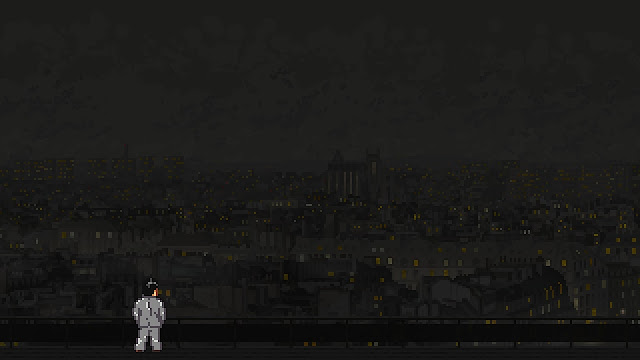
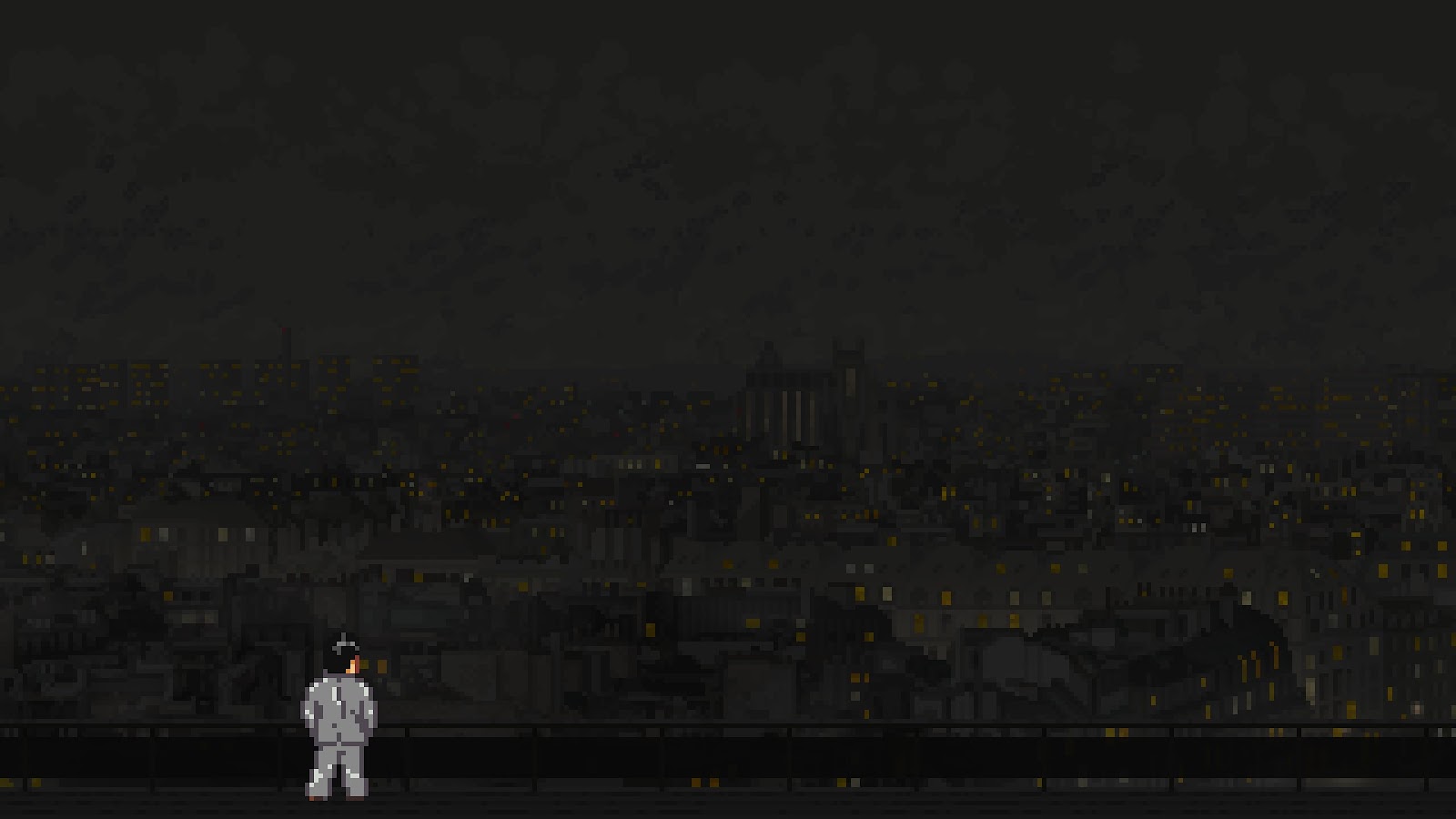
In 2020, yeo published his second 8-bit retro style game Arrest of a stone Buddha and in a more radical and minimalistic way, conducted his experiment on “duration” in the game. This more melancholy story about an assassin living in Paris 1976, is divided into two separate sectors which take turns forming a cycle: side-scroll, high intensity shoot’em-up; aimless wandering down on Paris’ streets.
In the former, you have to discover some rules yourself: your bullets are always lethal and always kill, but an absurd amount of enemies will run towards you, facing and from behind like waves and you can’t reload, so the only option you have is to rip a new gun straight from the nearest enemies’ hands right when you’re empty. On top of that you can only “slow-walk”, and can only take a couple of hits, and unless you reach a “transition point”, enemies will infinitely spawn. So you “have to” shoot every enemy right when they appear and before they fire and keep moving forward while repeatedly turning back to shoot any enemies spawn behind you at the same time, intensity reaching hysteria.
In the latter, on the other hand, after briefly talking to the middleman you are thrown right into the dim Paris streets and “completely aimless”. On the street block containing only a drug store(selling sleeping pills), a cinema, a bar(selling smoke, to buy when you're empty), a clothing store, your own apartment, a roof of a high rise with an elevator which contains nothing and a museum, your only goal is to wander. But no matter what you do, or do not do, time will still pass, cycling day and night, until the next “hit”. Sleeping pills can fast forward a night, but most of the days you can’t buy it, and you also can’t take it before a certain time. Except for the middleman you briefly talk to after every mission, you have basically zero NPCs to actually “interact with” on these Paris streets, except for the minimum dialogue when you buy stuff. And there's almost nothing to accumulate. You have nothing to do with no one, they’re like phantoms. There’s only you, and time.
It is until I don’t know how many nights that, when Erik Satie’s Gnossiennes No.1 plays, it hits me: isn’t this Louis Malle’s Le Feu follet? We’re like Alain Leroy in the film, just rehabilitated and came out of a hospital(from hysteria), but still cut off from a meaningful world. The same tune from Le Feu follet appears here hence summons a familiar soul, and he also has a lover. In the game, there’s a door on the streets, if you go in you will fade into (which appears to be) a woman’s apartment. But every time you go in (if you are allowed in), you will only see the protagonist sitting on the edge of the bed, and on the bed “seems to be” a sleeping woman turning her back to us, or maybe it’s just nothing? We have no idea due to the pixelated art style. I’ve been there a full day in-game, but except for the clouds outside the window, nothing changed, except for the befalling of the night.